Arctic Circle Aurora Tour From Fairbanks: What The Full-Day Trip Involves
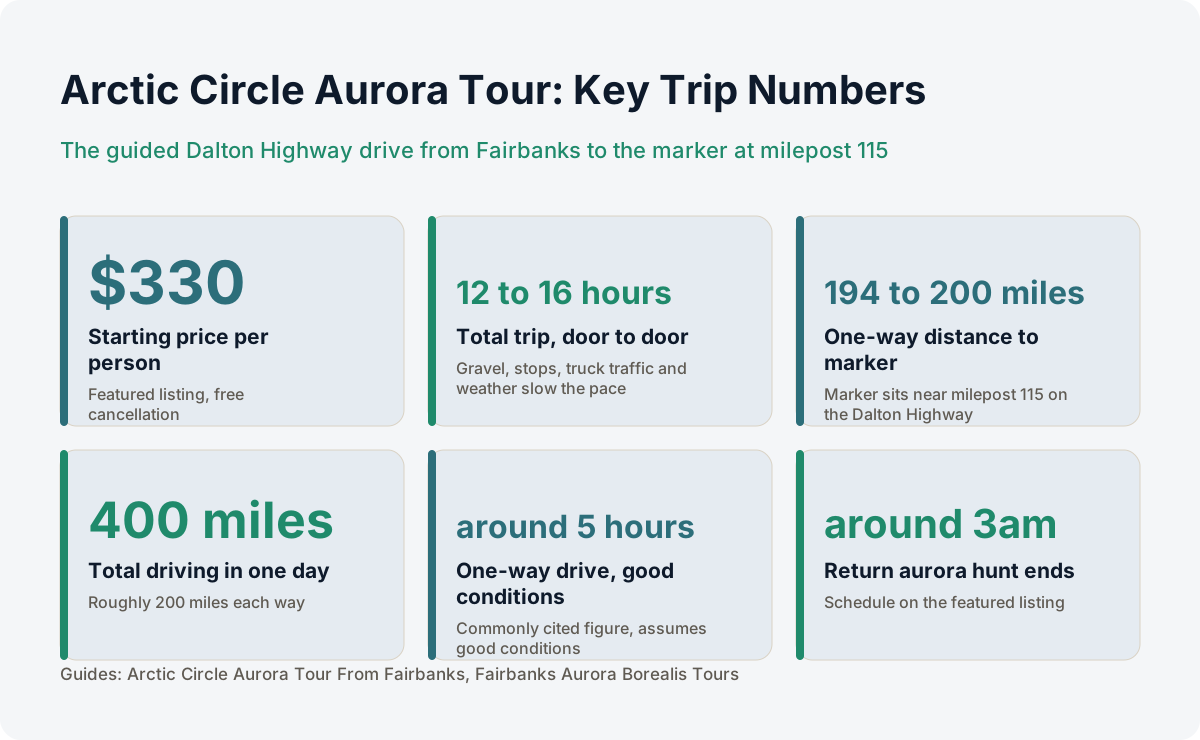
The Arctic Circle marker sits at milepost 115 on the Dalton Highway, roughly 194 to 200 road miles north of Fairbanks, and almost nobody drives there on their own. Here is what the full-day guided trip, with its return aurora hunt around 3am, actually asks of you.
Short answer
An Arctic Circle aurora tour from Fairbanks is a full-day Dalton Highway trip, commonly 12 to 16 hours round trip, to the Arctic Circle sign at milepost 115, roughly 194 to 200 miles north. The featured listing runs from $330 per person, rates 4.5 from 171 reviews, and returns with an aurora hunt around 3am.
What Is The Arctic Circle Aurora Tour From Fairbanks?
An Arctic Circle aurora tour from Fairbanks is a guided full-day drive up the Dalton Highway to the Arctic Circle marker at milepost 115, roughly 194 to 200 miles north of the city, with a return aurora hunt that typically wraps around 3am. Trips commonly run 12 to 16 hours door to door. It is a specialty-operator product, not a self-drive itinerary, and the featured listing runs from $330 per person.
The premise is simple and a little audacious: you leave Fairbanks, cross the Yukon River, follow the Trans-Alaska Pipeline corridor north over gravel, stand at the sign marking 66 degrees 33 minutes north latitude, and then drive back south after dark with the sky as the second half of the program. The aurora hunt on the return leg is the reason most people book this over a hilltop viewing night closer to town. You are already deep under the auroral oval, far from city light, and the vehicle is warm.
The featured product on this site is the Full-Day Arctic Circle Sign Trip, rated 4.5 from 171 reviews, from $330 per person, with free cancellation on the listing and a genuine "Likely to sell out" badge. The listing's schedule is full day, with the return aurora hunt approximately 3am, which tells you plainly what kind of day this is: long, dark at both ends, and unforgettable for exactly those reasons.
How Far Is The Arctic Circle Sign From Fairbanks And How Long Is The Drive?
The Arctic Circle sign sits near milepost 115 on the Dalton Highway at approximately 66 degrees 33 minutes north, roughly 194 to 200 miles from Fairbanks. One-way drive time is commonly cited around 5 hours under good conditions. Full-day round-trip tours run 12 to 16 hours, because gravel, stops, truck traffic and weather all slow the real pace.
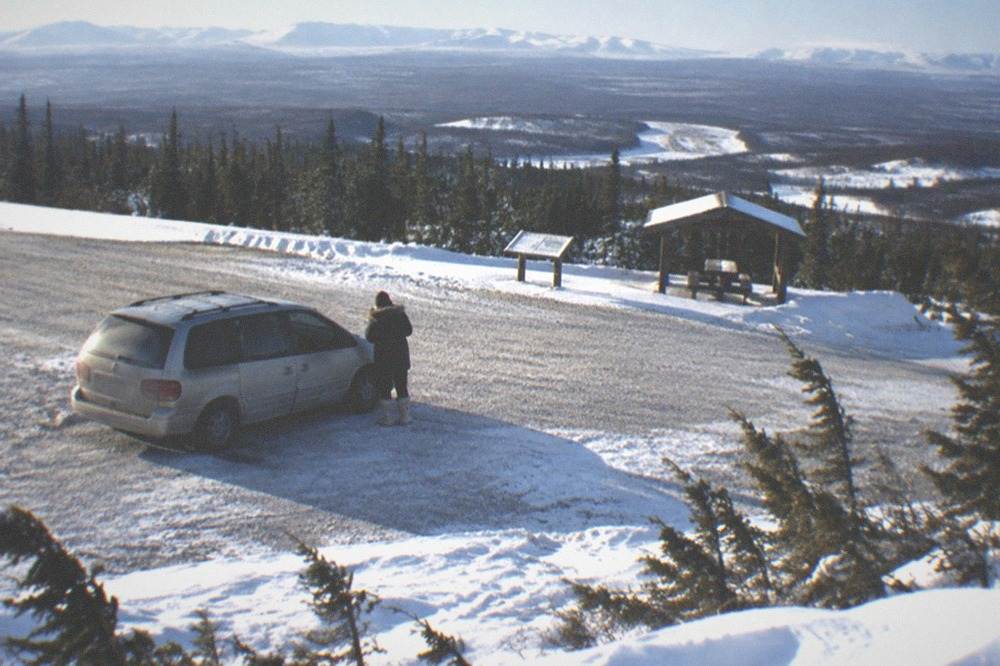
The Dalton Highway, locally called the Haul Road, begins at its junction with the Elliott Highway roughly 73 to 84 miles north of Fairbanks, depending on where you measure from the city. From that junction the marker is still hours of gravel ahead. The 5-hour one-way figure assumes decent conditions and few stops; guided tours stop at the Yukon River crossing, pipeline viewpoints, Finger Mountain, and the marker itself, which is the point of the day.
The arithmetic is what surprises people. Roughly 200 miles each way means 400 miles in a day, on a road that is largely gravel north of the Yukon, shared with industrial truck traffic serving the oil fields at Prudhoe Bay. Operators plan for that, and the tour day is built around it: a morning departure, a long daylight drive north in winter's short light, an afternoon at the marker, and the aurora hunt on the way home.
| Route point | Approximate location | What you see |
|---|---|---|
| Elliott Highway junction | Roughly 73 to 84 miles north of Fairbanks | Start of the Dalton Highway proper |
| Yukon River crossing | Dalton Highway mile 56 area | Bridge views and pipeline corridor |
| Finger Mountain | Dalton Highway wayside | Granite outcrop and tundra transition |
| Arctic Circle marker | Milepost 115, about 66 degrees 33 minutes N | The sign, certificate photos, tundra horizon |
Why You Cannot Self-Drive The Dalton Highway To The Arctic Circle
Most major national rental-car companies prohibit driving the Dalton Highway or void insurance coverage on it, so a self-drive Arctic Circle trip from Fairbanks is effectively closed to ordinary visitors. Only specialty and local Fairbanks operators typically run vehicles on the road. That single restriction explains why this product exists as a guided tour at all.
The Bureau of Land Management's Arctic Interagency Visitor Center states this plainly in its visitor guidance, and it is the one operational fact that shapes the whole market. A standard rental agreement from a national chain does not cover the Haul Road. If you drive it anyway, you are uninsured on a remote gravel highway where the next services are hundreds of miles apart and cell coverage is patchy at best.
Guided vans solve several problems at once. The operator carries the vehicle, the driver who knows the road's habits, the fuel margin, the communications, and the schedule. Winter adds snow, ice, blowing snow and refreeze black ice, with Atigun Pass at roughly 4,739 feet the best-known hazard stretch, though the pass lies well north of the marker. Travelers are advised to check 511.alaska.gov for real-time conditions, and the road is open year-round, open in the honest sense: plowed where it can be, graded when it can be, and never easy in winter.
There is a planning upside to all of this. Because the drive is operator-only, the decision is not whether to attempt it yourself but which guided product fits your trip. That comparison, between the Arctic Circle day trip, a Chena Hot Springs combo, and a dog sled aurora evening, is really a choice about how much of your day you want to spend on a bus and how far north you feel you need to stand. The marker itself confers no better aurora than a good hilltop closer to town; it confers a story and a certificate.
What A 12 To 16 Hour Arctic Circle Day Actually Feels Like
A full-day Arctic Circle tour from Fairbanks means roughly 400 miles of driving, much of it on gravel, bracketed by darkness at both ends of the day. In midwinter the sun rises near 11am and sets before 3pm, so most of the return leg, including the aurora hunt that wraps around 3am, happens in full night. Plan to sleep on the way home.
The shape of the day is unusual for a tour. You depart in the dark of an Interior Alaska morning, drive north through the short window of low light, and reach the marker around what passes for midday. The stops are real and unhurried: the Yukon River, pipeline photo points, Finger Mountain, the sign. Then the drive south begins as the light fails, and the second program starts.
That second program is the aurora hunt. The guide watches the UAF Geophysical Institute forecast and the sky, and the group stops where the odds look best on the way back toward Fairbanks. Fairbanks sits under the auroral oval at about 64.8 degrees N, so visible aurora is often possible at Kp values of roughly 2 to 4, lower than mid-latitude locations need, though the Kp index is a global rather than purely local predictor. No operator guarantees a sighting; the aurora is a natural phenomenon and every honest listing says so.
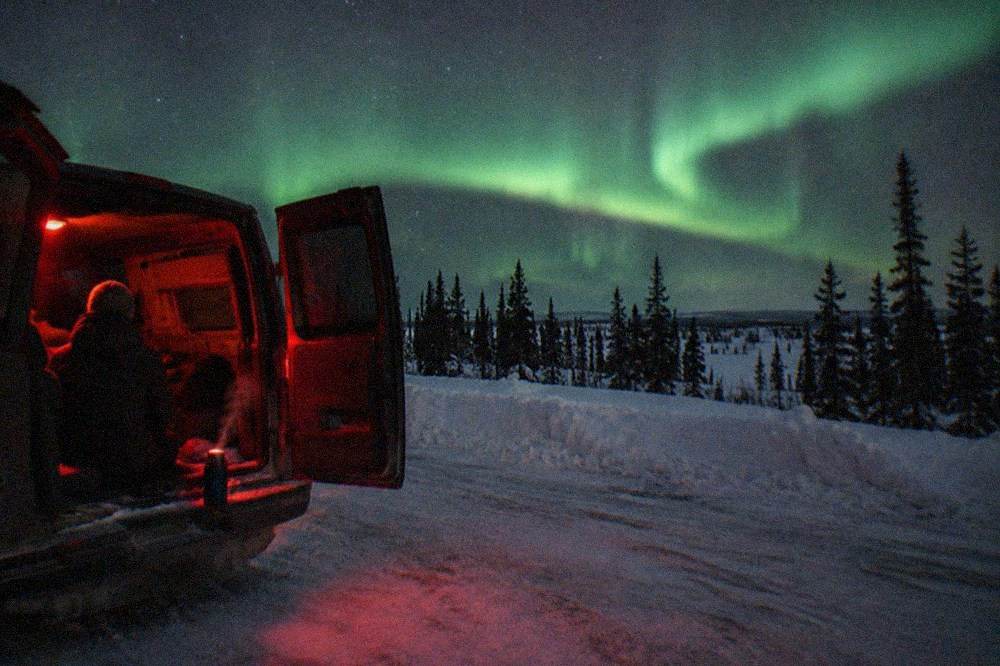
Practically, the thing to prepare for is endurance, not hardship. You will be warm and seated for most of the day; meals are not listed, so check the operator page. The fatigue is real. Book this on a day you can sleep in the next morning, and read the what-happens guide on what happens on a Fairbanks aurora tour for the general rhythm of these nights. If the sky is stubborn, the cloudy-night cancellation question is worth understanding before you book any aurora product, and this one carries free cancellation on the listing.
When Is The Best Time Of Season For An Arctic Circle Aurora Tour?
Fairbanks' aurora season runs August 21 to April 21, and the Arctic Circle trip only runs as an aurora product within it. The strongest combination of dark-enough nights and drivable road tends to sit between late August and early April, with equinox periods and midwinter both cited for viewing. The road is open year-round; the aurora is not.
The season window is not about solar activity, it is about darkness. Outside August 21 to April 21, twilight or the midnight sun over the far north prevents aurora viewing even if the magnetosphere is active, a point Explore Fairbanks, the official destination marketing organization, makes clearly. On the Arctic Circle version of the trip, that darkness comes bundled with a 400-mile day, so road weather matters as much as sky weather.
Midwinter offers the most darkness, and January's average highs around 1 to 2F with lows around -16 to -17F in Fairbanks define the cold end of the experience, often the coldest month of the season. The winter of 2025-26 was Fairbanks' coldest on record from December to March, averaging nearly -14F per the National Weather Service, which is a useful reminder that Interior Alaska cold is a serious variable, not a costume for photos. Early and late season trips trade some of that cold for shorter nights.
| Season window | Darkness | Road and cold reality |
|---|---|---|
| Late August to September | Long nights return quickly | Milder temperatures, early-season snow possible |
| October to November | Fully dark nights | Highs around 12 to 14F in November, lows near -2 to -4F |
| December to January | Maximum darkness, about 3 hours 41 minutes of daylight at solstice | Highs 1 to 5F, lows to -17F; extreme cold days |
| February to early April | Nights still long, about 10 hours of daylight by late February | Highs climbing from 12 to 13F in February toward 25 to 27F in March |
How The Arctic Circle Trip Compares With Other Fairbanks Aurora Tours
The Arctic Circle day trip, from $330 per person and rated 4.5 from 171 reviews, is the longest and most expensive mainstream aurora product from Fairbanks. A Chena Hot Springs combo runs from $275 per person at 4.5 from 1,342 reviews, and a dog sled dinner aurora evening from $320 per person at 4.5 from 140 reviews. You are choosing distance, soak, or sled.
Price per person, what the day actually contains, and the review pool behind the rating: those are the three things that decide between these trips. The Arctic Circle trip sells the far-north story and the certificate; the hot springs combo sells warmth and a resort night; the dog sled evening sells a compact dinner-and-lights experience without the 400 miles. None of the three guarantees the aurora, and the honest comparison is about which day you want to have if the sky stays quiet.
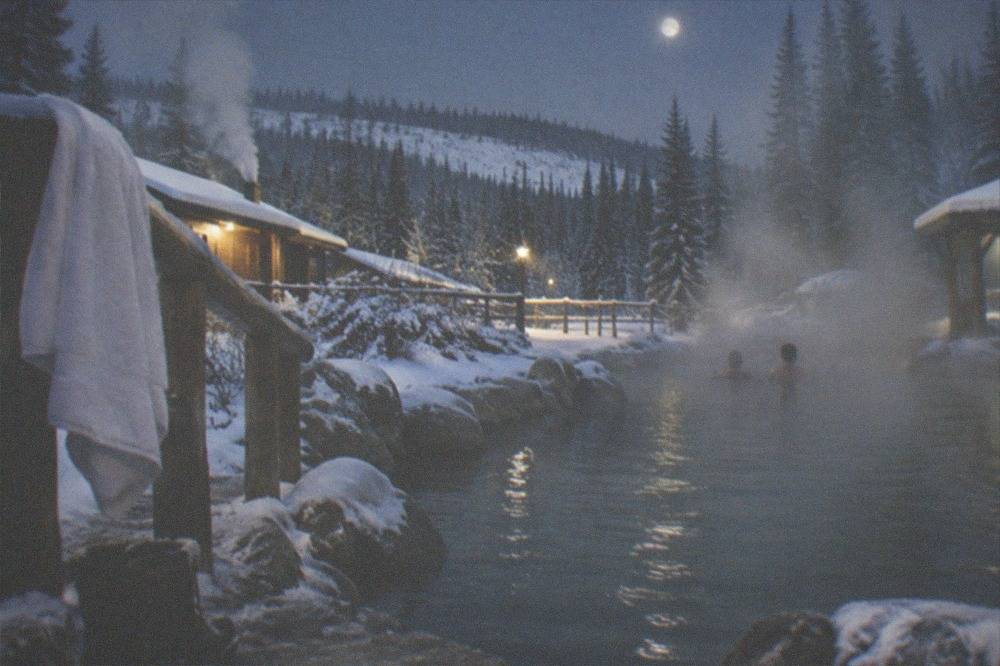
The hot springs option deserves a note. Chena Hot Springs Resort sits roughly 60 miles northeast of Fairbanks, about 1 to 2 hours' drive, with the outdoor pool open 7am to 11:45pm daily year-round and the Aurora Ice Museum held at a constant 25F with 45-minute tours. The Chena Hot Springs aurora guide covers that product in full if a soak sounds better than a haul.
| Tour | From, per person | Rating and reviews | The day in one line |
|---|---|---|---|
| Arctic Circle full-day sign trip | $330 | 4.5 from 171 reviews | 12 to 16 hours, Yukon crossing, marker, aurora hunt around 3am |
| Chena Hot Springs aurora combo | $275 | 4.5 from 1,342 reviews | Resort soak, Ice Museum, aurora viewing at roughly 60 miles out |
| Dog sled, salmon dinner, yurt | $320 | 4.5 from 140 reviews | Evening sled ride, dinner, yurt, aurora viewing |
The Chena combo, with 1,342 reviews behind its 4.5, is the most-tested listing of the three on this page, and it carries the site's featured-tour slot. That matters if you want the crowd-checked option rather than the longest one. The dog sled evening is the middle path: a real Alaska winter activity, a meal, and lights, all without committing a full calendar day.
For travelers weighing the drive itself rather than the aurora program, the Fairbanks winter driving conditions guide explains what the Interior's roads demand in the cold months, and the best time to see northern lights in Fairbanks guide covers the forecast side. Both feed the same decision: whether your trip has a spare 16 hours in it.
What To Bring On A Full-Day Dalton Highway Aurora Tour
Bring full winter layers, serious boots, and a plan to be outside at stops in temperatures that commonly run well below zero in midwinter. The listing includes the guided transport and the program; personal cold-weather gear is on you. Snacks, water, a headlamp with red light, and a phone battery pack round out the practical kit.
The cold math is unforgiving. January average lows in Fairbanks sit around -16 to -17F, and the Arctic Circle leg runs you further from help and deeper into the same air mass. Layers beat one thick coat, and boots rated for extreme cold beat fashion. The what to wear for a Fairbanks aurora tour guide has the detailed kit list; the short version for this specific day is that you spend more time standing at stops than you expect, and the aurora hunt involves repeated short exits into the cold.
Photography deserves a word. Phone batteries die fast in deep cold, so an external pack kept in an inside pocket is standard practice. Tripods and manual camera settings matter if you want more than a green smear; the dedicated Fairbanks aurora photography tours guide covers technique and the tours that teach it. On this trip, your guide's schedule, not the aurora forecast, sets the stops.
| Item | Why it matters on this trip |
|---|---|
| Extreme-cold boots and wool socks | Repeated outdoor stops at marker and aurora pullouts |
| Layered insulation plus parka | Sitting cold in a van, standing cold outside it |
| Headlamp with red-light mode | Light discipline during aurora stops |
| Phone battery pack | Cold drains batteries in minutes at subzero stops |
| Snacks and water | A 12 to 16 hour day with sparse services on the road |
Is The Arctic Circle Aurora Tour From Fairbanks Worth It?
For travelers who want the far-north story and can absorb a 12 to 16 hour day, the Arctic Circle trip earns its $330 per person starting price: a Yukon crossing, the marker at 66 degrees 33 minutes north, and an aurora hunt under an oval sky. If you only want lights with maximum comfort, a lodge or hot springs night is the better buy. The trip's badge, "Likely to sell out", is real.
The honest case against is comfort and odds. You will not see better aurora at milepost 115 than at a good hilltop nearer town; the physics is the same, the sky is the same oval. You may see it longer, since the return hunt spans the deepest night hours, but the 90 percent figure commonly cited for a three-night stay during the season, weather permitting, comes from staying multiple nights in Fairbanks, not from driving further in one night (see Driving To Fairbanks).
The honest case for is the day itself. The pipeline, the Yukon, the Haul Road's truckers, the tundra horizon, the certificate, and the drive back under a sky that occasionally ignites: that is a full Interior Alaska education in one push. Midwinter dark, at about 3 hours 41 minutes of daylight on the solstice, makes the trip feel properly arctic. Booking early matters because of the genuine sell-out badge on the listing, and the free cancellation on the listing makes an early booking a low-risk move. This page sits inside a wider roster at Fairbanks Aurora Borealis Tours, where the full comparison set lives.
Common Questions About The Arctic Circle Aurora Tour From Fairbanks
How far is the Arctic Circle from Fairbanks?
The Arctic Circle marker sits at milepost 115 on the Dalton Highway, approximately 66 degrees 33 minutes north, roughly 194 to 200 miles from Fairbanks. One-way drive time is commonly cited around 5 hours under good conditions, so full-day round-trip tours run 12 to 16 hours.
Can you drive yourself to the Arctic Circle from Fairbanks?
Most major national rental-car companies prohibit driving the Dalton Highway or void insurance coverage for it, per the BLM Arctic Interagency Visitor Center. Only specialty and local Fairbanks operators typically run vehicles on the road, which is why the trip exists as a guided tour.
How much does an Arctic Circle aurora tour cost?
The featured full-day listing runs from $330 per person, rated 4.5 from 171 reviews, with free cancellation on the listing and a real "Likely to sell out" badge. The return aurora hunt wraps around 3am.
Is the Arctic Circle tour worth it if you only care about the northern lights?
If aurora alone is the goal, closer options cost less and run warmer, such as a hot springs combo from $275 per person or a dog sled aurora evening from $320 per person. The Arctic Circle trip is worth it for the day, the Yukon crossing and the marker, with the aurora as the closing act.
What time does the aurora hunt happen on the Arctic Circle tour?
The return aurora hunt runs on the drive back toward Fairbanks and typically finishes around 3am, per the listing's schedule. The whole tour day is full day, commonly 12 to 16 hours door to door.
Is seeing the northern lights guaranteed on an Arctic Circle tour?
No. The aurora is a natural phenomenon and no listing guarantees a sighting. Fairbanks sits under the auroral oval, so visible aurora is often possible at Kp values of roughly 2 to 4, and a commonly cited figure gives roughly a 90 percent chance of seeing the aurora with a three-night stay during the season, weather permitting.