Aurora Photography Tours In Fairbanks: What The Camera-First Nights Cost And Include
Two Fairbanks listings build the whole aurora night around the camera rather than the view: one sells instruction and finished portraits, the other sells pizza and a heated shelter. The prices, review pools and formats differ more than the sky does.
Short answer
Fairbanks has two photography-format aurora listings. Photo Lessons And Portraits Included runs from $385 per person with a 5 rating from 245 reviews; Electric Moose pairs pizza and a heated shelter with a 5 to 6 hour outing from $300 per person, rated 5 from 14 reviews. Both beat a standard viewing tour only if images of you under the sky matter.
A standard aurora tour in Fairbanks asks one question of the night: where is the sky active. A photography-format tour asks a second one on top: what images leave with you. That second question changes the vehicle, the pacing, the stops and the price, and Fairbanks happens to offer exactly two listings built around it, which makes the comparison unusually clean.
What Does An Aurora Photography Tour In Fairbanks Actually Add?
A photography-format tour pairs aurora viewing with instruction: camera settings guidance, framing help, and often finished portraits of you under the sky. The two Fairbanks listings in this format run from $300 to $385 per person and both hold a 5 rating, though one draws on 245 reviews and the other on just 14.
The honest way to frame the add is this: nobody needs a photography tour to see the aurora from Fairbanks. The town sits under the auroral oval at roughly 64.8 degrees north, and the official season window, August 21 to April 21 as published by Explore Fairbanks, gives more than two hundred dark-sky nights a year. What a standard tour leaves you with is a memory. What a photography format tries to leave you with is a memory plus a memory card.
The instruction itself is practical, not academic. Autofocus hunts and fails in a dark sky, so a guide who tells you to switch to manual and rack the lens toward infinity saves most people twenty frustrated minutes. Cold drains batteries fast, so a guide who tells you to pocket the spares saves the second half of the night. Framing, foregrounds and the discipline of shooting before the display peaks rather than during it are the rest of the package. The portrait element is the part no standard tour replicates at all: someone else operates the camera while you stand in the frame, and you leave with images that include a person, not just a sky.
That split between "the sky is enough" and "the images are the point" is the organizing idea behind this page and the way Fairbanks Aurora Borealis Tours sorts every aurora product in town. If you own no camera and want none, the standard formats will serve you better for less money. If a finished picture of yourself under a green band is the souvenir you came for, the two listings below are the only ones built to deliver it.
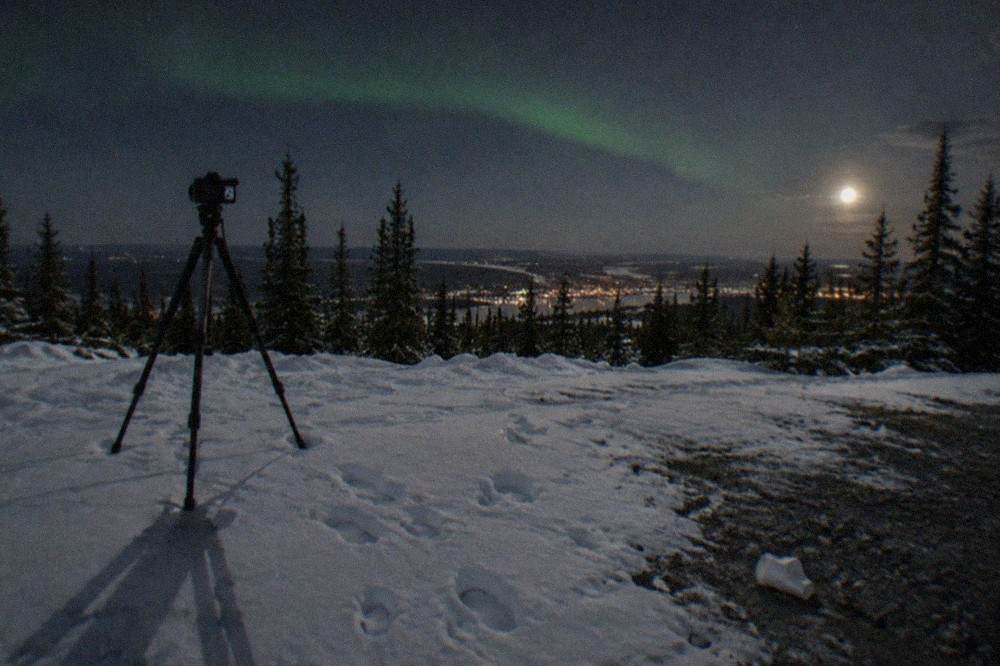
One caution belongs at the top rather than the bottom: the aurora is a natural phenomenon and no listing on this site, photography-format or otherwise, guarantees a sighting. What the photography formats guarantee, insofar as they guarantee anything, is that if the sky performs, the images are handled by someone who has shot it before.
Photo Lessons And Portraits Or Pizza And Shelter: The Two Fairbanks Photography Listings Compared
The photo-lessons listing ($385 per person, 5 from 245 reviews) builds the night around instruction and includes portraits; Electric Moose ($300 per person, 5 from 14 reviews, 5 to 6 hours) trades formal lessons for a heated shelter and pizza in a photography-format outing. The real difference is inclusions and comfort, not the sky.
Both listings carry the same headline rating of 5, but the review pools behind those numbers are not the same thing at all. The Photo Lessons And Portraits tour draws on 245 reviews, a pool large enough that a sustained 5 is meaningful. Electric Moose draws on 14. A 5 from 14 reviews tells you nobody has been disappointed yet; it does not tell you the format has been stress-tested by hundreds of nights and dozens of weather patterns. Anyone weighing the two should hold that asymmetry in view rather than reading the two ratings as equivalent.
The formats themselves diverge on what happens between displays. The photo-lessons tour is built around teaching: settings, composition, and then staged portrait opportunities with the guide operating the camera. The listing states pickup from the Fairbanks area, with the exact meeting point shown on the listing. Electric Moose takes a different route to the same camera-first idea: a 5 to 6 hour outing with a heated shelter and pizza, run by a photography studio, so the shooting infrastructure is there but the night is organized around warmth and food as much as instruction.
The price gap, $85 per person between the two, is mostly explained by the portrait product. Finished portraits of travelers under an aurora are the single most labor-intensive thing either listing sells: someone has to compose, shoot, and presumably curate or deliver the images afterward. Pizza and a heated room, by contrast, are logistics. Neither price point is out of line with what a premium aurora chase costs in this market, but they buy noticeably different nights (see Private Aurora Tours).
Electric Moose also carries something the instruction tour does not state: free cancellation on the listing. For a Fairbanks winter product, where a cloudy night can scrap the whole outing, that flexibility has real value, and it is the one concrete term on which the cheaper listing is also the more forgiving one.
| Feature | Photo Lessons And Portraits Included | Electric Moose, Pizza And Shelter |
|---|---|---|
| Price | From $385 per person | From $300 per person |
| Rating | 5 from 245 reviews | 5 from 14 reviews |
| Duration | Not stated on the listing | 5 to 6 hours |
| Core inclusions | Photo lessons, portraits included | Photography-format outing, pizza, heated shelter |
| Cancellation | Not stated on the listing | Free cancellation on the listing |
| Best fit | Travelers who want images of themselves | Travelers who want comfort and a long warm night |
Read down the columns and the two listings stop looking like competitors and start looking like different products. One sells an instructor and a portfolio. The other sells a studio-built night out with a camera along for the ride. A traveler who would never pose under the lights anyway is paying $85 for a service they will not use; a traveler whose whole goal is that one picture of the family under the aurora is getting it cheap at $385.
How Much Does A Fairbanks Aurora Photography Tour Cost?
The two photography formats run from $300 to $385 per person. Standard viewing spans wider: from $99 per person for a budget Murphy Dome hilltop to $335 for a premium small-group chase. Cancellation terms vary by listing: the Moose outing carries free cancellation, and several others state no policy at all.
Every price in this comparison is per person, and every price here is the published from-price on the tour's own listing. Set against the rest of the Fairbanks roster, the photography formats sit at the top of the price range but not outside it. A premium small-group chase runs $335, a Chena Hot Springs combination runs $275, and the full-day Arctic Circle trip runs $330, so $300 to $385 for a camera-first night is squarely within what this market charges for premium formats.
| Listing | Format | From (per person) | Rating |
|---|---|---|---|
| Photo Lessons And Portraits Included | Photography, lessons, portraits | $385 | 5 from 245 reviews |
| Electric Moose, Pizza And Shelter | Photography, shelter, pizza | $300 | 5 from 14 reviews |
| Premium Aurora Viewing Tour | Small-group chase | $335 | 5 from 789 reviews |
| Hot Springs Combo, Chena Resort | Resort + aurora | $275 | 4.5 from 1,342 reviews |
| Guided Lodge Viewing | Lodge viewing, commentary | $200 | 4.5 from 286 reviews |
| Lodge And Yurt Viewing | Lodge and yurt windows | $160 | 4.5 from 34 reviews |
| Budget Hilltop, Murphy Dome | Hilltop viewing | $99 | 4.5 from 317 reviews |
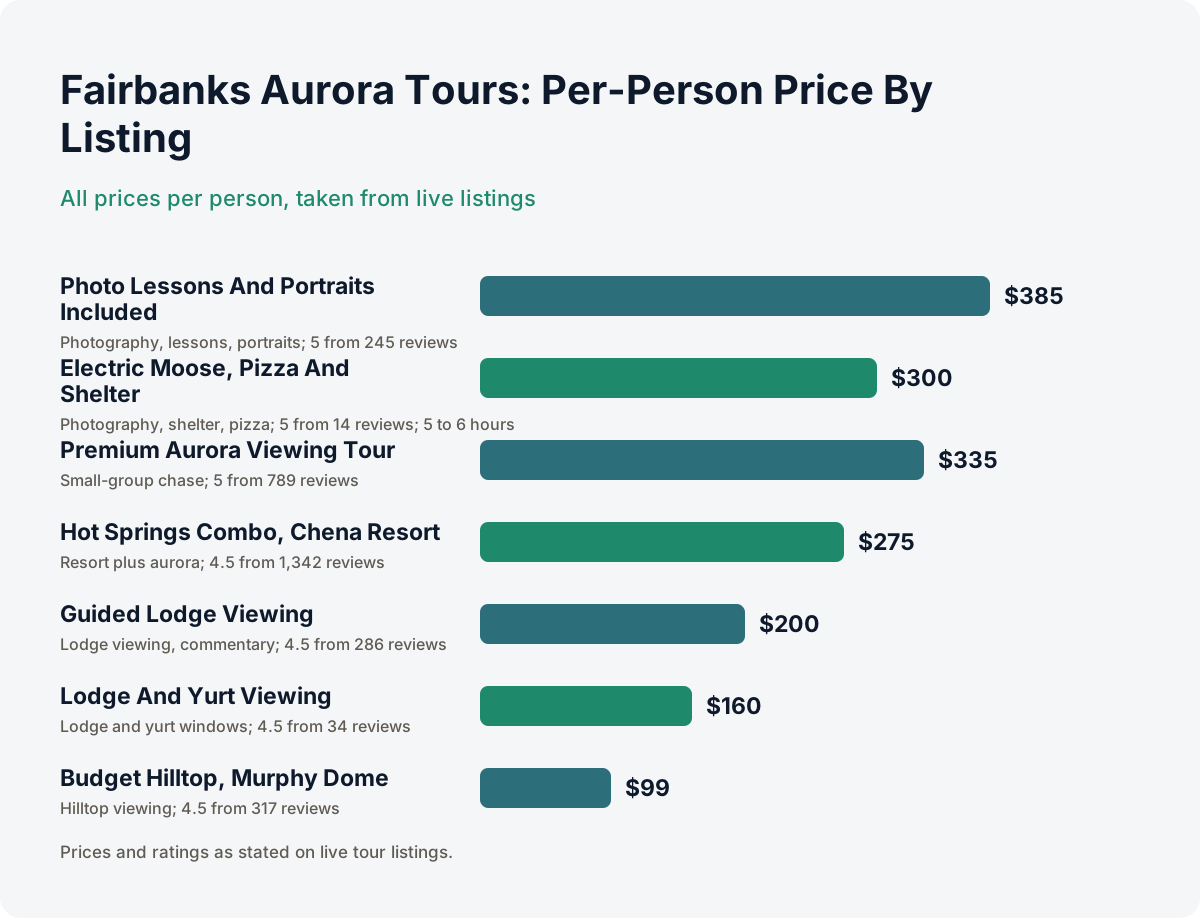
The interesting line in that table is the premium chase at $335. It is only $50 cheaper than the portrait tour and $35 more than the Electric Moose outing, yet it is a pure viewing product with a 5 rating drawn from 789 reviews, the deepest pool on the roster. That is the clearest statement of what the photography premium actually buys: not a better aurora, but a night organized around your camera and your image. If the images are the point, the premium is small. If they are not, it is pure cost.
For the portrait tour specifically, $385 per person buys the full instructional arc plus the staged shooting of travelers themselves, the one product on this list that cannot be substituted by bringing your own tripod. The Electric Moose format, at $300, shares the photography framing but reallocates the budget toward shelter and food, which on a midwinter night at 10 or 20 below is not a trivial trade.
One budgeting note that applies to whichever format wins: these prices cover the tour product, not the resort add-ons some travelers bolt onto a Fairbanks aurora trip. General-admission entries like the Chena Hot Springs Ice Museum, $20 for adults and $15 for children, are resort prices, separate from any aurora tour listing, and should not be folded into a tour comparison.
What Camera Settings And Gear Do You Need For Fairbanks Aurora Photos?
Plan on a fast wide lens at f/2.8 or faster, manual focus near infinity, and a starting exposure around ISO 1600 to 6400 with shutter speeds of roughly 5 to 15 seconds. A sturdy tripod is not optional in an interior Alaska winter, and spare batteries kept warm matter nearly as much.
Treat the ranges below as starting points, not settings. The aurora moves at different speeds, and a static display tolerates a 15 second exposure while a fast band blurs at anything longer than 5. The whole craft of aurora photography is adjusting between those two ends of the dial as the night changes.
| Setting or gear | Common starting range | Why it matters at Fairbanks |
|---|---|---|
| Aperture | f/2.8 or faster | The sky is dim; every stop of light matters |
| ISO | 1600 to 6400 | Higher brightens the display, at the cost of noise |
| Shutter speed | 5 to 15 seconds | Long enough for light, short enough to freeze the curtains |
| Focus | Manual, set near infinity | Autofocus fails against a dark sky |
| Batteries | 2 to 3 spares, kept in an inner pocket | Cold drains cells far faster than the display drains them |
| Tripod | Sturdy, wind-stable | 15 second exposures cannot be handheld |
The reason a settings table belongs on a tour-comparison page is simple: the instruction-format tours exist precisely to teach this table on the spot. A guide who watches your screen and says "drop the ISO, the band is moving fast" compresses an evening of failed exposures into ten useful minutes. Travelers shooting on their own at a lodge or hilltop learn the same lessons eventually, one blurry frame at a time.
Two local factors sharpen the gear question beyond what a generic aurora guide would say. First, interior Alaska cold is battery poison: spares stored in an outer pocket die almost as fast as the one in the camera. Second, midwinter nights run long enough that a tripod stands in snow for four or more hours, so cheap aluminum legs that shake in a breeze will ruin shots no setting can rescue. For clothing, the layering question is its own subject, covered in detail in what to wear on a Fairbanks aurora tour, and it matters more on a photography night than on any other format, because you stand still for hours instead of moving to stay warm.
Photography Tour Or Standard Viewing: What Changes On The Ground Near Fairbanks?
A photography format slows the night down: the guide paces stops around shooting windows, helps with settings, and stages portraits, while a standard chase optimizes for finding active sky and moving to it. The premium chase ($335 per person, 5 from 789 reviews) wins on mobility; photography formats win on finished images.
The distinction is easiest to see at the extremes. A budget hilltop product at $99 per person drives a group to Murphy Dome and parks; the viewing is what it is. A premium chase at $335 has a guide reading the sky and relocating when a cloud bank sits on the first stop. A photography format reorders the same night around the camera: less driving between venues, more time planted on a spot with a known foreground, and a guide whose job includes your exposure triangle.
For travelers who want the broader landscape of formats before committing, the lodge and cabin options are laid out in Fairbanks aurora viewing lodges and cabins, and the full roster is ranked and compared in the best northern lights tours in Fairbanks. The short version: viewing formats cluster between $99 and $275, and the camera-first formats occupy the $300 to $385 tier at the top.
The portrait tour is the one listing where the photography framing changes the product most. See the Photo Lessons And Portraits tour page for the full listing details, or Check availability once the forecast and your dates line up.
There is one honest scenario where the photography premium is wasted money: the traveler whose camera is a phone, whose interest in settings is zero, and whose goal is simply to watch. Phones now capture bright aurora passably, and a standard viewing tour with a warm room will serve that traveler better at a lower price. The photography formats earn their tier only when a real camera, real instruction, or a real portrait is part of the goal.
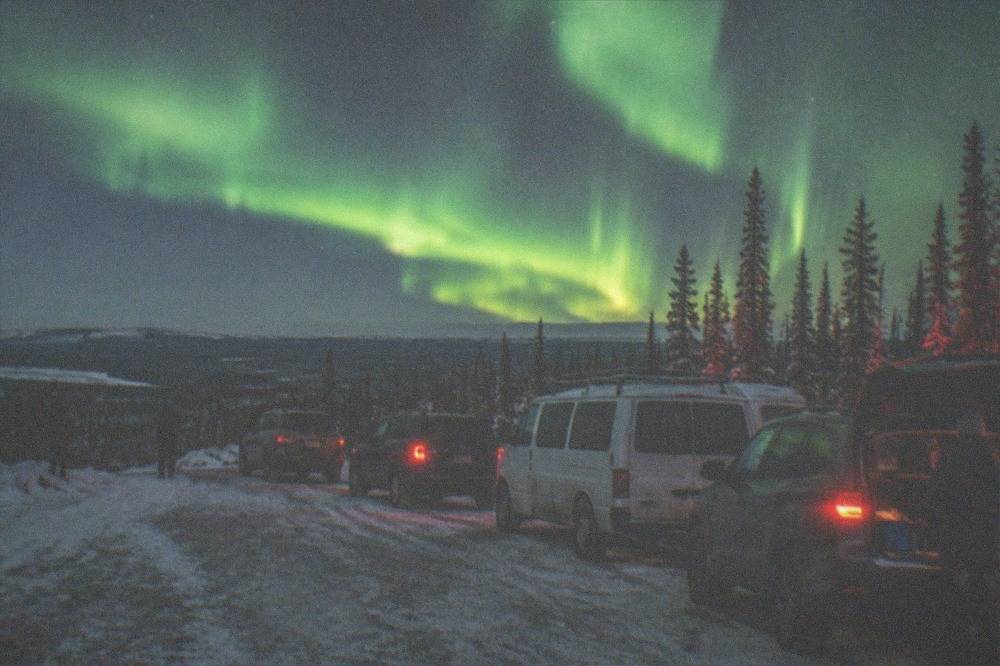
The reverse scenario is just as real. Serious photographers on a short Fairbanks stay often lose their first night to the learning curve: wrong lens, wrong focus mode, dead battery by midnight. A guided photography night front-loads the mistakes into an hour of instruction instead of an entire night of misses, which on a two or three night trip is the difference between coming home with frames and coming home with a story.
When And Where Around Fairbanks Do Photography Tours Shoot Best?
Fairbanks' aurora season runs August 21 to April 21, set by darkness rather than solar activity. Midwinter gives the longest shooting window, about 3 hours 41 minutes of daylight on December 21, while equinox months carry a commonly cited activity edge. Season nighttime lows run roughly -2F to -17F depending on month.
The season window is a darkness fact, not a solar one: outside August 21 to April 21, twilight or the midnight sun blocks viewing even when the aurora is active overhead. Within the window, the monthly trade is between cold and dark. Midwinter nights run fourteen hours and more, which means more potential shooting hours, but the coldest months push gear and bodies hardest.
| Month | Average high | Average low | Note for photographers |
|---|---|---|---|
| November | 12 to 14F | -2 to -4F | Long nights arrive before deep cold does |
| December | 4 to 5F | -12 to -13F | Solstice daylight about 3 hours 41 minutes |
| January | 1 to 2F | -16 to -17F | Often the coldest month; battery management dominates |
| February | 12 to 13F | -10 to -11F | Daylight stretches to about 10 hours by late February |
| March | 25 to 27F | -3F | Equinox activity edge; the most comfortable shooting |
Forecasting is the other half of timing. The University of Alaska Fairbanks Geophysical Institute publishes a daily aurora forecast built on the Kp index, a 0 to 9 planetary geomagnetic scale. Because Fairbanks sits under the auroral oval, visible aurora often appears here at Kp 2 to 4, values that would leave mid-latitude skies empty, though the index is a global measure rather than a purely local one (see Aurora Timing Tonight).
The "where" question interacts with the format more than most travelers expect. Open-vehicle formats shoot from wherever the guide stops. Lodge and glass-house formats shoot from a fixed heated position, which changes everything about tripod setup and battery care. The glass house at Cleary Summit, a 270-degree heated room with floor-to-ceiling windows, runs from $179 per person with a 4.4 rating from 38 reviews, carries free cancellation, and wears a real "Likely to sell out" badge on its listing. For a photographer who wants a long-exposure night without standing in the cold for it, a heated glass venue is arguably a third photography format, unbranded as one.
The long nights that make Fairbanks a photography destination also cut the other way. On a midwinter schedule, a 10pm pickup and a 3am return bracket five dark hours, and a photography-format tour that runs 5 to 6 hours uses most of the productive window. Travelers pairing a photography night with a second, standard viewing night should stagger them rather than stack them; the coldest weeks punish anyone who plans two consecutive 3am finishes.
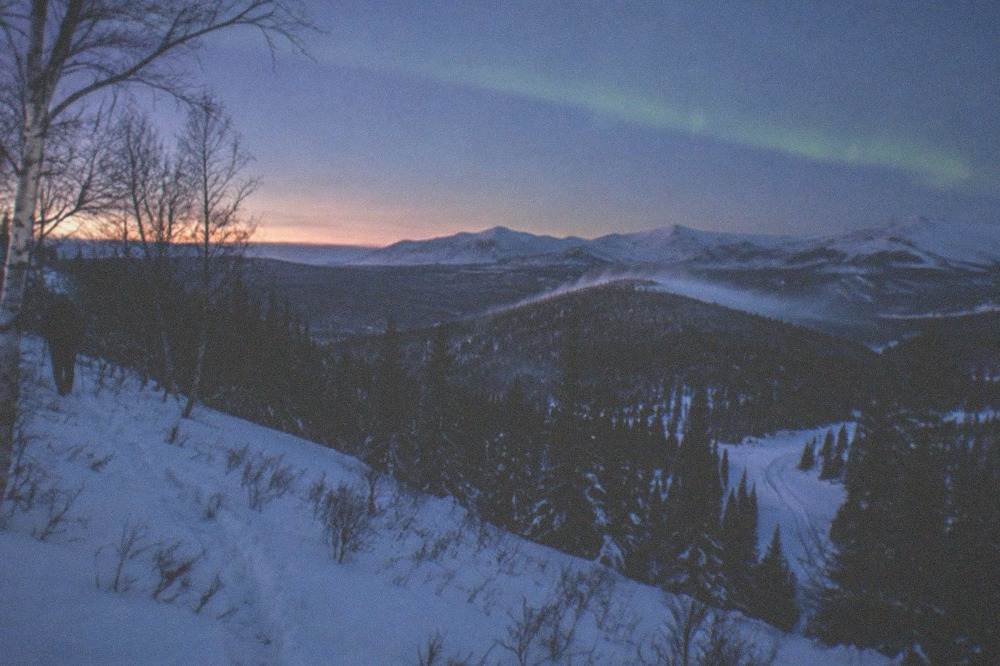
Pull the whole decision together and it reduces to three sentences. If finished images of people under the aurora are the goal, the portrait tour at $385 is the only listing that delivers it, and 245 reviews behind a 5 rating say it delivers reliably. If the goal is a camera-first night with warmth and food built in, the Electric Moose format at $300 with free cancellation is the comfortable pick, with the honest caveat that only 14 reviews stand behind it. And if the goal is simply the most active sky a guide can find, the premium chase belongs on the shortlist alongside them.
Whichever way the comparison lands, the timing rules hold for all of them: book inside the August 21 to April 21 window, watch the daily forecast rather than trusting any single night, and give the trip two or three dark nights so weather has room to break in your favor. The sky over Fairbanks does most of the work; the tour you pick decides what you carry home from it.
Common Questions About Aurora Photography Tours In Fairbanks
Do I need my own camera for a photography-format aurora tour?
The listings do not state camera rental terms, so check the live listing before assuming either way. Broadly, the instruction format works best if you bring a camera you will keep using after the trip, since the settings lessons transfer to your own gear. The portrait element, where the guide shoots you under the lights, does not require you to own anything.
Is a photography tour better than a standard aurora chase in Fairbanks?
Neither is better; they optimize different things. A standard chase, like the premium small-group tour at $335 per person with a 5 rating from 789 reviews, optimizes for finding active sky and moving to it. A photography format at $300 to $385 optimizes for time on tripod, guided settings and portraits. Pick the format that matches what you want to leave with.
How cold does it get on a photography night near Fairbanks?
Average lows run from about -2F in November to -16F or -17F in January, the often coldest month, with highs from around 1F to 27F depending on the month. The winter of 2025-26 was Fairbanks' coldest on record, averaging nearly -14F from December through March, per the National Weather Service. Cold matters more on photography formats because you stand still behind a tripod instead of moving.
Can a photography tour guarantee I see the northern lights?
No, and no listing on this site claims otherwise. The aurora is a natural phenomenon, and even under a strong forecast, local cloud can end a night. A commonly cited figure holds that a stay of three or more nights in season gives roughly a 90 percent chance of a sighting, weather permitting, with the aurora visible on about four of five clear nights.
Which Fairbanks photography tour should a beginner pick?
The Photo Lessons And Portraits listing at from $385 per person is the one built for beginners, with a 5 rating from 245 reviews behind it. The Electric Moose outing at from $300 per person is better for travelers who want a photography-flavored night without a formal lesson, and its free-cancellation term makes it the lower-commitment first booking if the forecast is uncertain.
Are portraits included, or an extra charge on the tour?
On the Photo Lessons And Portraits listing, portraits are included, per the listing's own inclusions. On the Electric Moose format, the listed inclusions are the pizza and heated shelter rather than portrait shoots, so treat finished images of yourself as a feature of the $385 listing specifically, not of the format in general.